
Is Scotty Bowers, the famous Hollywood pimp telling the truth about Spencer Tracy and Katharine Hepburn? Here's a confirming story...



|

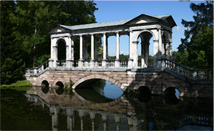
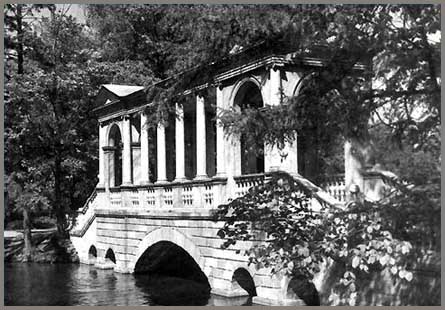 The Marble Bridge A little further on, before one reaches the Marble Bridge, there is a narrow path which, turning to the left, leads to an arbor in the form of a four-faced granite pyramid. It was built under Catherine the Great in 1771. At its sides stand four small columns, while behind it, on the bank of a small stream, under three marble slabs, lie Empress' three favorite dogs, the bodies of the Great Sir Tom Anderson, Zemir and Duchesse.
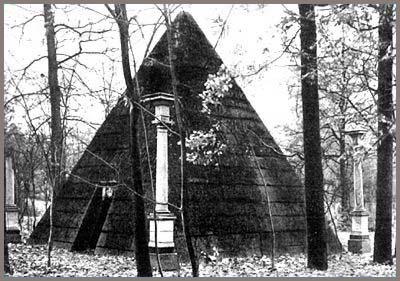 Dog Tomb The inscription on one of these slabs was composed by the Count de Segur, the French ambassador at the court of Catherine II. It reads as follows:"Here, lies Zemir, and the saddened Graces should throw flowers on her grave. Like Tom, her ancestor, like Lady, her mother, she was constant in her affections, swift of foot, and her only fault was that she was rather bad tempered; but her heart was of the best. When one loves one fears everything, and Zemir passionately loved Her, whom the whole world loves, as she did. Could she be good-tempered, having such a multitude of rivals? The Gods witnesses of her tenderness, ought to have rewarded her for her fidelity with immortality, so that she might for ever remain near her mistress."Passing the arbor the road returns to the Marble Bridge. This is a copy of one of the creations of the celebrated Italian architect Palladio. It was built by Nilov about the year 1778. It is evidently a result of the architect's sojourn in England, where he, in all probability, had seen a similar bridge in Lord Pembroke's park at Wilton. The resemblance has been remarked by the Englishman Coxe, who visited Tsarskoe Selo in 1778. The bridge itself is of stone, but its balustrades, which were prepared at Ekaterinburg, are of blue and white marble. They were set up by an Italian, named Tortori, who was sent on purpose from Ekaterinburg. The bridge spans a small inlet which joins the large lake and one of the small ponds which form here quite a lagoon of inlets and canals. Among them lie the Swan Islands. From one side the water enters from Vitolov Pond in the shape of a brook, which winds past Ruins Hill, the cast-iron Gothic Gate and Sugar Hill. From the other side the water flows along the canal in a swift stream from Rampovaya Avenue and Red Bridge with its two small towers. After crossing Marble Bridge the road continues to wind along the bank of the lake; to the right in a grove of trees can be seen two bright yellow wooden pavilions joined by a fence - they are in the Louis XVI style. They form a bathing place, erected in the reign of Catherine II for her grandsons to swim in. They were afterwards given to the Lyceum boys, and are now used by the members of the Imperial family, when present at Tsarskoe Selo in the summer. On the left side of the road a small brook runs from the grove under a bridge on the right, another small island rises from the lake. The brook springs from the celebrated fountain The Milkmaid. Pushkin dedicates pretty verses to it: "The maiden dropped the urn against a rock and smashed it, the maiden sits sadly, holding the useless remains."The fountain was erected in 1810 by Betancourt, the figure is the work of P. P. Sokolov. The fountain represents Peretta from La Fontaine's fable "The Milkmaid" or, "The Pitcher of Milk". Here is a translation of the fable by Kachovsky: "Comfortably and lightly dressed, placing the pitcher of milk on her head, in short skirts and barefoot, Peretta hastened to town to the market. Giving the wing to daydreams as she went, this young milk-girl decided, that if her customer was liberal with his money, she would buy eggs and raise chickens at home and feed them and guard them so well, and defy master fox; for she would arrange everything so cleverly and wisely. She would sell the chickens, and of course, buy a suckling pig; in order to raise a pig no great expenses would be entailed. She would like to know, what might hinder her from buying in the town a cow and a little bull; it would be sufficient reward for her for the trouble she took with them to look after them jumping among the herd. At that she jumped herself so high that she dropped the pitcher and spilt the milk, and with it lost her cows, pigs, and chickens! In despair she sat and looked at the remains, and at the pool of spilt milk, afraid to go home and face the anger there."In 1877 the water in the fountain began to fail; and since there were no drawings in existence, Engineer Cherniavsky, the manager at that time of the Taitsky Water Works, was commissioned to trace out the causes of the water failing. It turned out, that the water was conducted through wooden pipes from an underground spring in a stratum of sandstone, under the black earth of the lawn, in front of the terrace. Cherniavsky mended the pipes, and the water runs as plentifully as ever. According to an analysis conducted by Dr. Gutovsky in 1910, it seems, that this water is not so pure as that of the Orlovsky Springs, which now supply the Tsarskoe Selo Water Works. A few paces from the fountain, on the bank of the lake, is a wide granite landing-place, adorned with two bronze copies of antique statues. Formerly this landing place was connected with the island by a ferry boat. About 150 paces further, on a little cape amidst flower beds, stands a bust in bronze of the late Tsarevich Nicholas Alexandrovich. |